Follow the adventures of one fearless little explorer as she discovers the wonders Australia has to offer.
Showing posts with label dinosaurs. Show all posts

Friday, September 27, 2013

Winton, QUEENSLAND

Being fascinated by Australia's rich dinosaur history we travelled back inland to the small country town of Winton to view the famous fossils of Banjo and Matilda and the dinosaur footprints at nearby Lark Quarry.

The Australian Age of Dinosaurs musuem was fascinating. Situated on a sheep farm 20 kms from Winton the site covers a large mesa formation or Jump-Up. The mesa is a natural flat-top plateau 7 km long, 2 km wide, and rising 75 metres above the surrounding plain. The museum is located on top of the mesa, a wilderness area surrounded by steep cliffs, massive boulders and deep gorges.


It is home to the world's largest collection of Australian dinosaur fossils, including some of our most famous such as Australovenator (Banjo) and Diamantinasaurus (Matilda). It's also the site of Australia's largest fossil preparation laboratory.
The dinosaur bones are from rocks found in the Winton Formation, a geological layer 102-98 million years old. Since excavations began, several types of dinosaurs have been found, including plant-eating ankylosaurs and ornithopods, plus the serrated teeth of carnivorous theropod dinosaurs.

In 2009, three new species of dinosaur were formally scientifically named from Winton:

*   Australovenator wintonensis , Australia's most complete meat-eating dinosaur. (Banjo)
*   Diamantinasaurus matildae , a huge long-necked stocky plant-eating dinosaur. (Matilda)
*   Wintonotitan wattsi , a long-necked gracile plant-eating dinosaur. (Clancy)


Australian Age of Dinosaurs, Winton, QUEENSLAND

The famous Australian poet Banjo Patterson who wrote Waltzing Matilda in Winton in 1885 was the inspiration for the nicknames given to the fossils found.
In a quirky twist of fate, Banjo (Australovenator) and Matilda (Diamantinasaurus) were both found buried together in what turns out to be a 98 million-year old billabong. Banjo Patterson's story of Waltzing Matilda describes the unfortunate end to a swagman who steals a jumbuck (sheep) but is chased by police and ends up leaping into and drowning in a billabong alongside his stolen sheep.

HISTORY
It is believed by some that plant eating Matilda was looking for a drink when she found herself stuck in mud and Banjo (being a carnivore) decided she was an easy target but found her unreceptive. It is thought she struck back at him with her huge tail and he also became stuck in the mud and they perished together.


Matilda-
Diamantinasaurus and Wintonotitan are the first new sauropods to be named in Australia in over 75 years, the most recent being Austrosaurus in 1933.
Sauropods (meaning lizard-footed) are large, four-legged, herbivorous dinosaurs and diamantinasaurus is the best preserved sauropod skeleton so far found in Australia.
This plant-eating, four-legged sauropod is a new type of titanosaur. Titanosaurs were the largest animals ever to walk the earth.
Matilda was a solid and robust animal, probably akin to a gigantic hippopotamus and is estimated to be approximately 15 to 16 metres long, 2.5 metres high at the hip and weighed approximately 15 to 20 tonnes. She is estimated to have lived 100-98 million years ago in the Mid-Cretaceous (Latest Albian) period.


This is what Matilda would have looked like.


Banjo-
A carnivorous theropod, Banjo is the most complete meat-eating dinosaur skeleton yet found in Australia. He is estimated to have lived 100-98 million years ago in the Mid-Cretaceous (Latest Albian) period.
Australovenator is considered as Australia's answer to Velociraptor for its speed, razor-sharp teeth and three large slashing claws on each hand. At approximately 5 metres long, 1.5 metres high at the hip and weighing 500 kg, Australovenator was many times bigger than Velociraptor.
Theropods (meaning beast-footed) are mainly, but not exclusively, carnivorous bipedal (two-footed) dinosaurs. Unlike other theropods like T Rex that have small arms, Australovenator's arms were a primary weapon with the three large slashing claws on each hand.
Banjo can be classified as an allosauroid therapod, sharing many features with primitive allosaurs. It is most closely related to the Japanese Fukiraptor and Neovenator from the Isle of Wight, England.
The discovery of Australovenator has helped solve a 28-year mystery surrounding an ankle bone found in Victoria which was controversially classified as a dwarf Allosaurus. Now that Australia's most complete carnivorous dinosaur skeleton has been found, it can be confirmed that the 1981 bone belonged to the lineage that led to Australovenator.
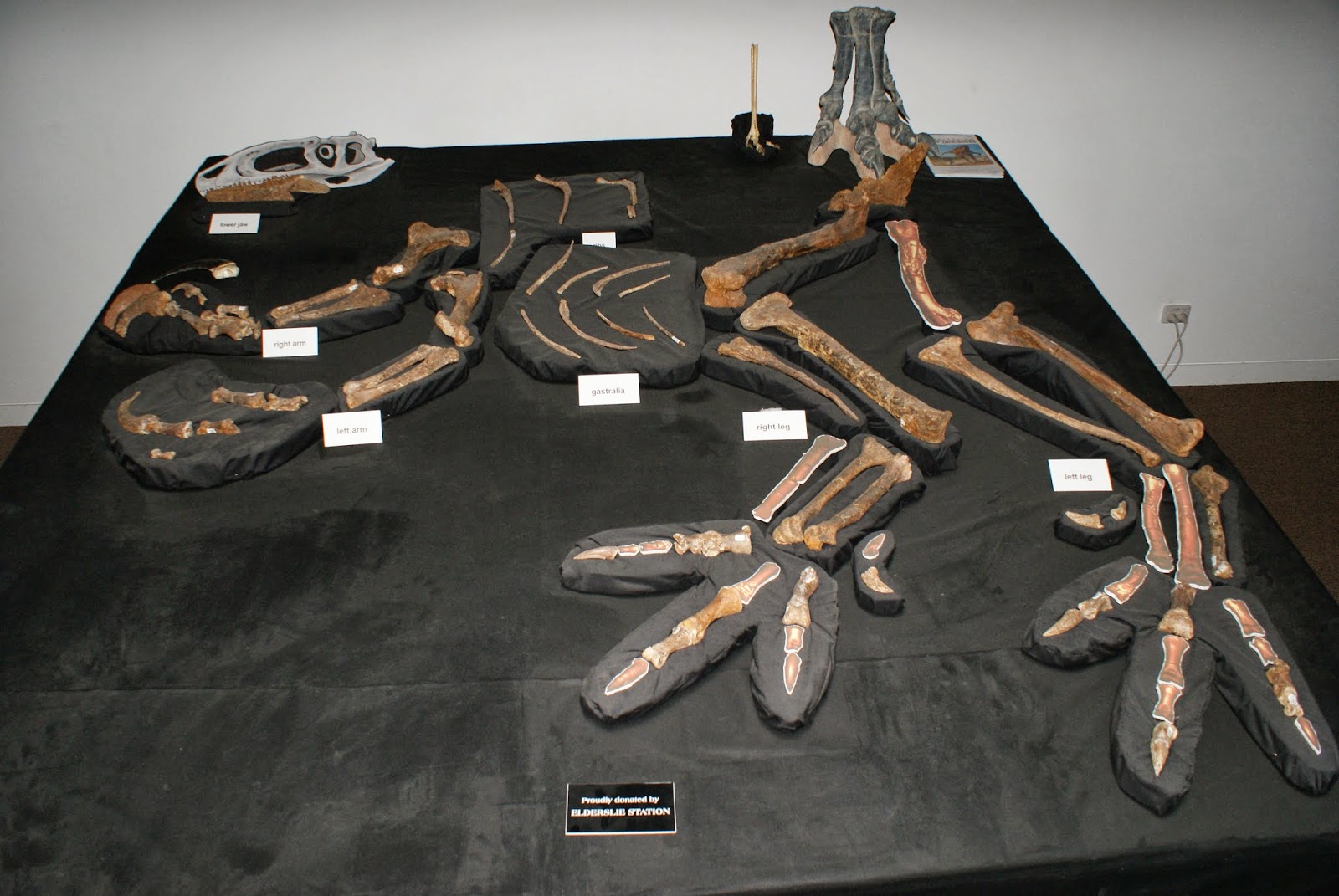

And Banjo was pretty fearsome too!


Lark Quarry, near Opalton, QUEENSLAND
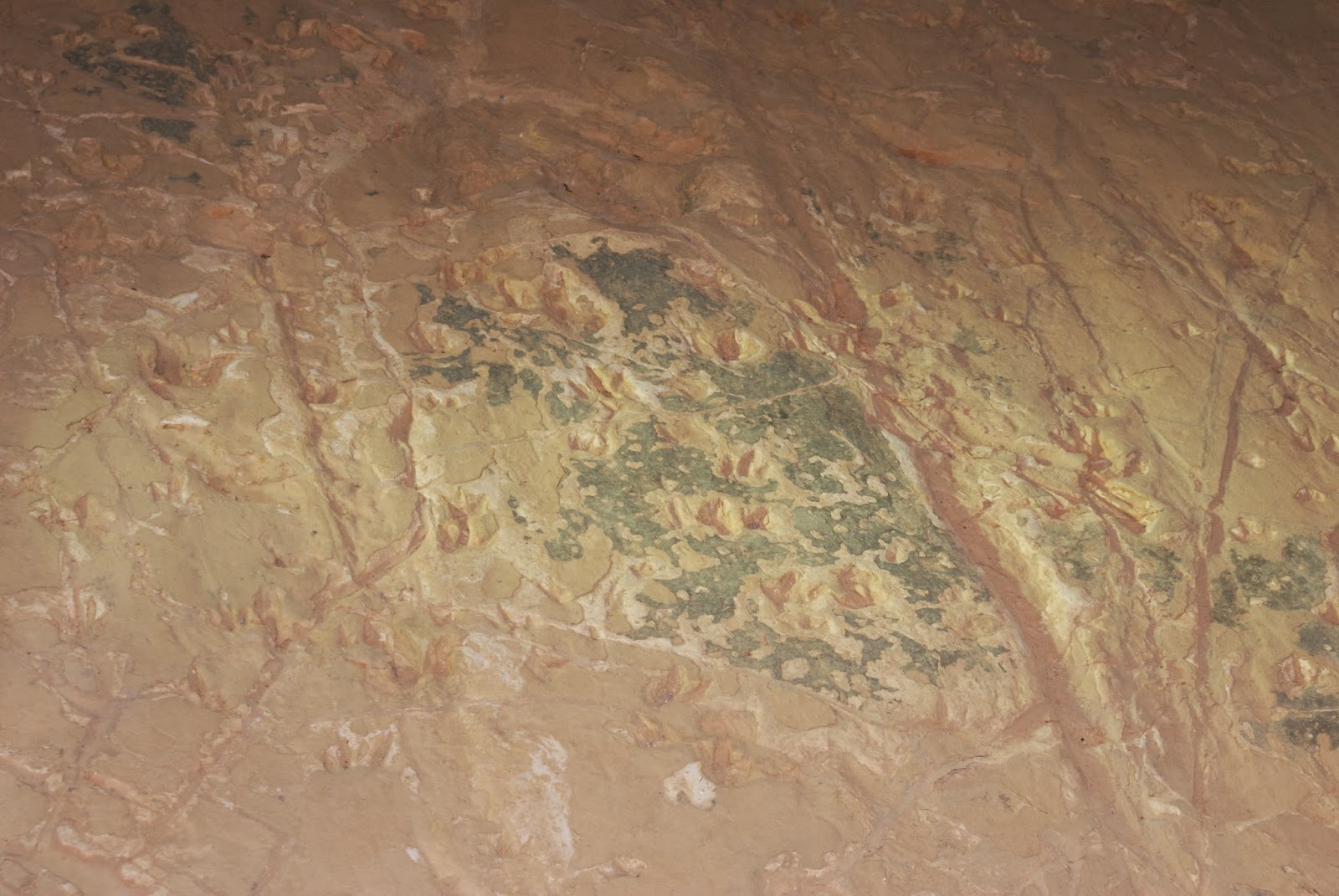
In the outback near Winton, Lark Quarry is believed to be the only recorded dinosaur stampede on earth. The footprints were discovered in the 1960s by station manager from a nearby quarry. The Dinosaur Stampede National Monument was included in the Australian National Heritage List on 20 July 2004, for values of rarity and research.


Around 95 million years ago, a large herd of around 150 small two legged dinosaurs gathered on the banks of a forest lake to drink. The herd was stalked by a large Theropod - four tonnes of sharp-clawed, meat-eating dinosaur. The herd panicked, stampeding across the muddy flats to escape the Theropod's hungry jaws. A record of those few terrifying minutes is cast in more than 3300 fossilised footprints. The footprints tell us about a cooler, wetter world, when dinosaurs roamed the earth.


Palaeontologists from the Queensland Museum and the University of Queensland excavated Lark Quarry during 1976-77 (the quarry was named after Malcolm Lark, a volunteer who removed a lot of the overlying rock). Altogether they removed more than 60 tonnes of rock, uncovering about 210 square metres of the layer with the fossils. A sheltering roof was built over the site but did not stop the gradual damage caused by exposure to the weather so in 2002 the Conservation Building was constructed to protect the main collection of footprints by stabilising temperature and humidity fluctuations, stopping water running over the footprints and keeping people and wildlife off the footprints.


It was very difficult to photograph the footprints so I hope they at least resemble what they're supposed to!


Opalton (down the road 100 kms or so) is a remote outpost for Opal Mining with no general store or supplies but a campsite where showers can be purchased for $2. We did the Winton, Lark Quarry, Opalton Loop of 300 kms and would not recommend it to people travelling with young children. There was nothing there! Aside from this welcome...


And this Outpost Store which is open sometimes I assume.


And a monument to the harsh unforgiving land... reminding people to carry water as a young man died here.


Friday, August 9, 2013

Dinosaurs anyone? Richmond, Queensland

We had no idea that Australia has such a rich dinosaur history, apart from the obviously named Dinosaur Cove down in Victoria, that is. We were so surprised to find Kronosaurus Korner and further fuel the fascination that Amelia has for fossils. (And her mother some would say! ;)

Kronosaurus Korner, located in Richmond, Queensland (despite the off-putting spelling) was simply brilliant. The town Richmond is about 400 kms east of Mt Isa which was where we had to stay for a few days. I haven't taken any photos in Mount Isa, the mining town as we weren't able to do much touristy activities given Amelia was too young. But I made up for the in Richmond with numerous photos of the spectacular fossils and dinosaur remains, some dating back 100 million years. Amelia was in her element, racing around the museum excitedly, only slowing down to listen to the audio guide every now and then. She was particularly impressed with the children's corner where she was able to play at palentology and uncover her own dinosaur skeleton. The musuem is well placed in the middle of an impressive area for fossils and is still a working laboratory, with regular digs and archeological work being undertaken to restore items discovered.

The best part of all is the way the general public has been involved in the entire musuem, with regular station owners finding fossils on their land in the course of their daily farming life. People are invited to partake in fossicking and share their finds with the "experts". In this post I'll endeavour to explain some of the more important finds...

At the entry is a giant lifesize model of the kronosaurus, a short necked pliosaur (a marine reptile) which was discovered nearby. A fascinating fact relating to the size of this monster is that it's teeth were 30 cms long- or about the size of a big banana.


This pliosaur fossil was discovered by a team from Harvard University from a site near Richmond in 1932. The tip of it's skull which was found is 54 cms in length, shown here against a crocodile skull indicating it's true size to be much larger. The complete skull is guessed to be 2 metres in length- he was huge! Twice the size of the skull of a Tyrannasaurus Rex. 


The pliosaur was a marine reptile having lived during the time when much of western Queensland was a shallow Cretaceous inland sea, approx. 120 million years ago. Only a few of these have been found, with many in the same area of Queensland. It was named Kronosaurus after the Greek God of the time, Kronos who ate his own children. The Australian kronosaurus lived for a long period of time, estimated at 16 million years so scientists believe there were probably many different species. Kronosaurus were also found in northern Columbia, South America. The contents of the stomach of the fossils recovered indicated their diet consisted of fish, large sharks, turtles and other marine creatures. 


The map showing where the inland sea was and the altered coastline.

The fossilised skeleton below is of an Ichthyosaur- or "fish lizard". The ichthyosaur was a dolphin like reptile that ruled the ocean during the age of the dinosaurs. They had large flippers and a tail like a shark and were very powerful swimmers. Their excellent eyesight enabled them to see clearly in the ocean depths and they fed on large squid like creatures and other fish. They lived in the sea 100 million years ago and grew to be 7 metres in length. This one was found nearby on the Sutherland cattle station, 100 kms north west of Richmond.


Also found in the area was an Elasmosaur- a long necked reptile with a smaller head than the kronosaurus. This animal would have been 8 metres long, with more than half that being the length of his neck. Many of the fossils found have been minus the head- which would easily have broken off over the years under the ground. 


Ammonities were another common find in the area- very similar to today's Nautilus. They are also related to the octopus and cuttlefish. They are easily recognised by their coiled shape and chambers within. The interesting thing is that only the chamber right next to the opening was occupied by the animal. As it grew, new chambers were created and the older ones filled with liquid and gas which enabled the animal to move up and down in the water. 

They were named after the ancient Egyptian God Ammon who was depicted as having horns on his head. The largest ammonite found was a big as a tractor tyre. They had eyes, jaws and tentacles, and could propel themselves through the water using a type of jet propulsion.


Turtles were also found in the Richmond area. The most common; Notochelone, is similar in size to today's green turtle. 


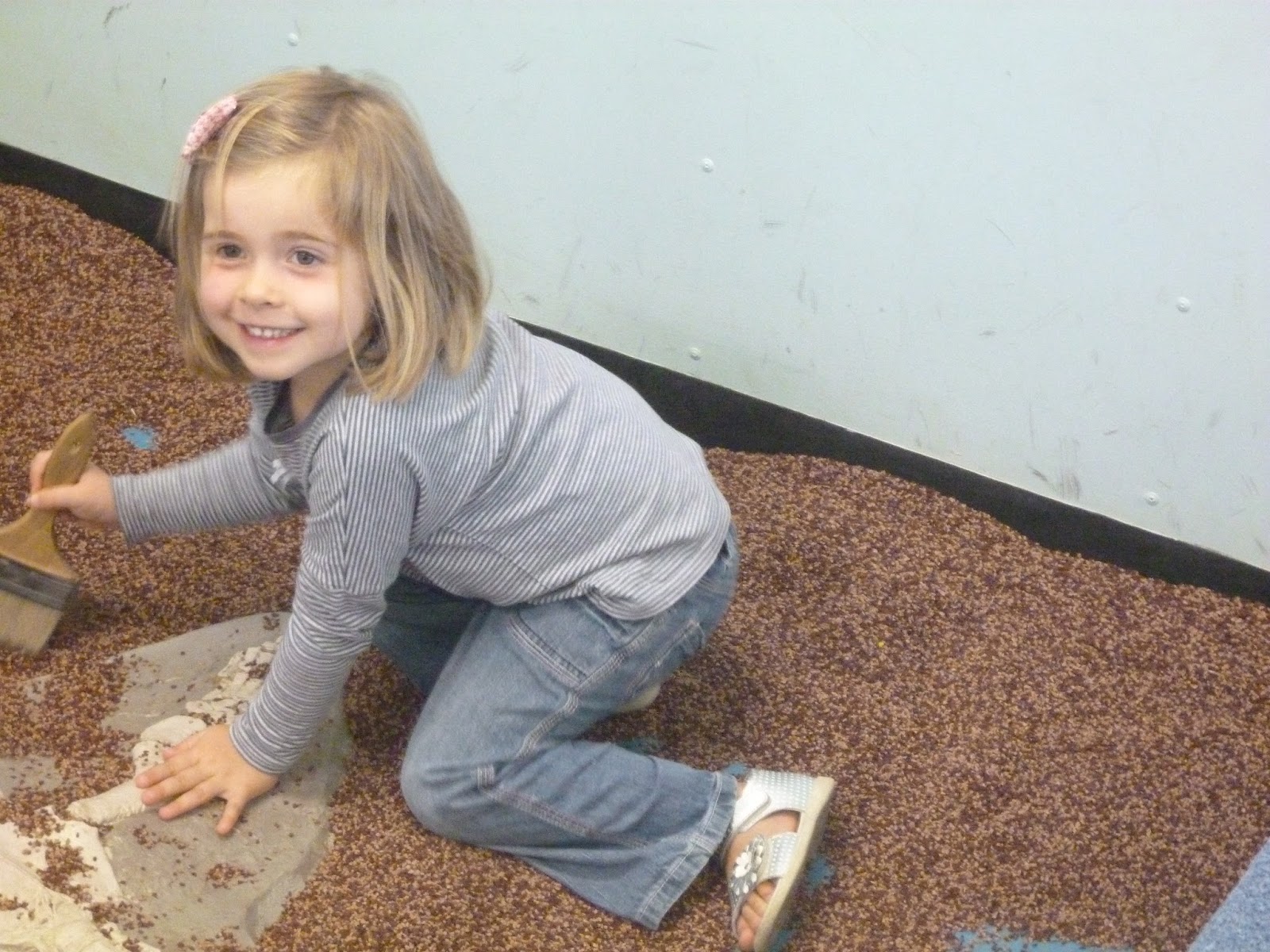
 Here's our little palaeontologist hard at work near the incredible laboratory.


Various fish fossils have been found in remarkably good condition...


Cooyoo Australis, which grew up to 3 metres long was a giant high speed predator


The next dinosaur we saw was called Minmi, who was land based and it lived about 100 million years ago.


 What Minmi would have looked like.

And the most well preserved giant pliosaur (not really a dinosaur- a marine reptile) was present.. It's on loan from QLD Museum and is considered an excellent specimen, having been relatively quickly buried in marine sediment and limestone. This one had been injured before death possibly by a kronosaurus, and has an injured flipper. It was most likely killed by a blow to the head

 I just found a little photobomber in the background of this shot!


As you can imagine we loved learning more about Australia's exciting dinosaur history and the day was a great success with Amelia. (We're also planning to visit the site of the largest known dinosaur stampede in the world- in Winton, just down the road)